simulia – Resources
Simulia – Resources
Simulia Alternatives: Best Engineering Simulation Tools 2025
Maintaining agility in the modern manufacturing landscape requires more than just standard design tools; it demands a robust integration of simulation, data management, and strategic engineering support. For many US-based manufacturers, partnering with a premier SOLIDWORKS reseller provides the necessary foundation to scale operations, but the real competitive edge often lies in high-end virtual testing. By leveraging advanced platforms such as Simulia, engineering teams can predict product performance under real-world conditions long before a physical prototype is ever printed. This synergy between CAD design and sophisticated simulation ensures that mid-market and enterprise organizations in sectors like aerospace and automotive remain leaders in innovation and reliability.
The Core Fundamentals of SIMULIA and Abaqus for Modern Engineering
To understand the current state of virtual testing, one must first explore exactly what Simulia represents within the broader Dassault Systèmes ecosystem. Essentially, it is a comprehensive suite of engineering simulation and analysis tools designed to help researchers and engineers evaluate materials, assemblies, and structural integrity. At the heart of this suite is the abaqus software, a world-class finite element analysis (FEA) tool renowned for its ability to handle complex nonlinear problems. While traditional CAD-integrated simulation is sufficient for basic stress tests, the deeper capabilities of this ecosystem allow for multi-physics simulations that account for thermal, fluid, and mechanical interactions simultaneously.
For manufacturers working with a dedicated SOLIDWORKS reseller, the transition into these advanced environments is often facilitated through seamless data bridges. The software works by discretizing a physical model into smaller elements—the finite element method—which allows the system to solve mathematical equations across the entire geometry. This granular approach is what makes Simulia the industry standard for high-fidelity simulation. By mimicking the exact physical environment a product will face, companies can reduce development costs and accelerate their time-to-market.
Understanding the Distinction Between Abaqus and 3DEXPERIENCE Solutions
A common point of confusion for many engineering managers is the difference between standalone legacy tools and the modern cloud-integrated versions. Specifically, when comparing Abaqus to 3DEXPERIENCE simulia, the distinction lies primarily in the deployment and collaboration framework rather than the underlying solver technology. The traditional simulia abaqus environment is typically a desktop-based installation, offering deep control over solver settings and localized high-performance computing. It is the go-to choice for power users who require specific, highly customized simulation workflows.
Conversely, the 3DEXPERIENCE version brings these powerful solvers to a cloud-native platform. This transition enables global teams to share simulation results in real-time, ensuring that data management and version control are handled automatically within the cloud infrastructure. For a manufacturer integrated into a wider DELMIAWorks ERP or PDM environment, the cloud-based approach often provides superior visibility across the entire product lifecycle. While both versions utilize the same industry-leading solver technology, the 3DEXPERIENCE platform focuses on breaking down silos between designers and simulation specialists, fostering a more iterative and collaborative development cycle.
Diverse Industry Applications and Educational Solutions
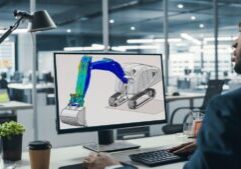
The versatility of these tools is evidenced by the wide range of sectors that rely on them for mission-critical development. In the aerospace industry, engineers use the abaqus software to simulate fatigue analysis on airframe components, ensuring they can withstand decades of pressurized cycles. The automotive sector employs these tools for crashworthiness testing and battery safety evaluations in electric vehicles. Beyond these, industrial equipment manufacturers use the software to optimize the weight of heavy machinery without compromising structural strength.
Recognizing the need for future talent, there are also specialized simulia solutions for education. These packages allow universities and technical colleges to provide students with the same high-tier tools used by Fortune 500 companies. Educational licenses often include comprehensive tutorials and reduced complexity interfaces to help students master FEA principles. This academic outreach ensures that the next generation of engineers is proficient in using simulia abaqus before they even enter the workforce, providing a steady stream of skilled professionals ready to manage complex manufacturing challenges for US firms.
Strategic Synthesis of Simulation and Manufacturing Systems
The integration of advanced simulation tools into a wider manufacturing strategy represents the pinnacle of modern industrial engineering. When a company utilizes a SOLIDWORKS reseller to manage its design licenses and then scales into high-performance FEA, it creates a closed-loop system of innovation. This connection is vital when deploying additive manufacturing solutions, such as Markforged 3D printers, as it allows engineers to simulate the performance of composite parts before they are printed. By understanding part behavior virtually, manufacturers avoid material waste and structural failures in the field.
Ultimately, the goal of implementing simulia is to create a "digital twin" of the manufacturing process. From the initial CAD sketch through simulation, PDM-managed data storage, and ending with ERP-synchronized production, every step is optimized for efficiency. This holistic approach captures the essence of what it means to be a modern manufacturer in 2025. By embracing these sophisticated tools, organizations can ensure their products are not only designed with precision but are also tested to the highest standards of safety and performance. The synergy between simulation, professional training, and systems integration remains the most reliable path to achieving long-term technical excellence in a demanding global market where precision is non-negotiable.
Additional Resources:


Companies that trust GSC